


As a child, I have often been fascinated by the glittering paintings that were hung along the hallway of my mama’s house. These resplendent masterpieces added a different aura to the whole place so much so that I still remember them, even after so many years of him having moved into his new house.
That very spirit of admiration for the same has seemed to reemerge as a consequence of my new found love for Indian culture.
My fascination knew no bounds when I delved deep into this age-old art form.
Dating back to the 16th century, the “Tanjore or Thanjavur” paintings can be known as the by-product of the Maratha invasion over South India; Tamil Nadu to be specific.
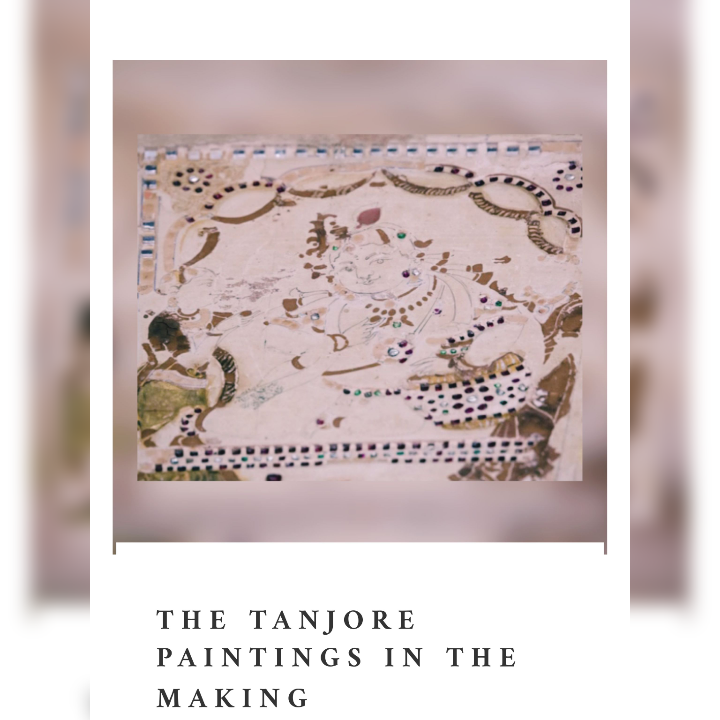
As an initial step, a canvas is made. A wooden board derived from the bark of a jackfruit tree was used as the base on top of which a cardboard sheet is pasted using indigenous gum, with a stretched piece of cloth over it. Then it is overcoated with a mixture of chalk and tamarind seed powder and finished up with an Emery paper to give it the required texture and form what is referred to as the ‘Palagai Padam’ by the locals of Tamil Nadu. (Palagai; wooden plank),Padam (painting).
The artists then sketch out sceneries from the Ramayana and the life of Krishna or even simple sketches of elephants, horses and cows in it with the help of templates. These pinpricked tracing sheets are placed on top of the cloth and dusted with charcoal dust. Originally relief areas were made over these sketches by using a mix of chalk powder, glue, gold paint and water which is now to be replaced by plaster of paris.22-carat gold foil is pasted on these embossed areas for the final touches and of course not to forget the colourful semi-precious stones used to accentuate the beauty of the effect.
With time the artisans shifted from natural dyes to synthetic colours. (dark colours for the border, Red, Blue and green for the background, Lord Vishnu in blue and Natraja in white).
Our Colonizers(the British)had created their version of the same beauty with lesser use of the gold foil but the traditional material and processes are undoubtedly very intriguing. Just like any other of our traditional art forms, even these fragments of our heritage need to be protected and popularized amongst the youth of today.
Picture and info credits:
http://www.dsource.in/resource/tanjore-paint-ing-tanjore-tamilnadu/contact-details
ing-tanjore-tamilnadu/contact-details
https://medium.com/@VinitaMathur/thanjavur-painting-a-traditional-form-of-art-d3fc7968fc07
http://www.varrmas.com/tanjorepaintings
 Life is an art