Chocolate : The gift of the Gods

Chocolate,  conceived today as a delectable bar with mighty aphrodisiac potential, was originally a pretty bitter beverage, invented around 4000 years ago. Owing its existence to The Olmecs (, the earliest of the Latin Americans), revered later as the ‘Gift of the Gods’ by the Mayans (Inhabitants of what today comprises of southeast Mexico) and the Aztecs(indigenous people of Mexico before the Spanish conquests).

Going over to some interesting yet alarming anecdotes, The Mayans and the Aztecs, who believed in the divine properties of chocolate, initially used it for ritualistic and medicinal purposes. In on such ceremony practiced by Aztecs, the victims of a particular sacrificial ritual were asked to indulge in this heavenly sin with a hint of the previous victim’s blood on it. This was done to counter their melancholy, moments before their own demise. As Grotesque as it may sound, what surprised me, was the additional ingredient of chilies that the Mayans added in their so called “bitter water”; the original recipe of chocolate. I wouldn’t be surprised if these guys popped out of a time machine looking for a chocolate bank to protect their chocolate, which they deemed even more valuable than Gold, using it thus as a form of currency.

Imagine getting paid in bars of Cadburys or with a nice big box of Lindt. I mean we all love chocolate but we would like to keep our paychecks as well! However, you’d be surprised to learn that during the revolutionary wars in America, the soldiers were paid with these delightful treats as a form of payment.

After all these facts, it might come to you as a surprise as to why modern chocolate is sweet and not bitter, except for what we refer to as dark chocolate. It was much after the 18th century, with the onset of the industrial revolution, and the invention of the steam engine that chocolate started being manufactured in bulk. It was then that different varieties of chocolate were invented by many like the Dutch physicist Coenraad Van Houten, who invented cocoa powder and S.Hershey with his invention of chocolate-coated Caramels. Thereafter what once was a privilege only reserved for aristocracy, became a heavenly sin to be indulged by all of mankind. After all, chocolate is and will always be one of mankind’s greatest inventions.

Info:

https://www.smithsonianmag.com/arts-culture/a-brief-history-of-chocolate-21860917/https://www.history.com/topics/ancient-americas/history-of-chocolate

https://www.chocolate.org/blogs/chocolate-blog/a-brief-history-of-chocolate

Traditional bengali bangles -‘Shakha Pola’

Just like the tradition of wearing the ‘Chooda’ amongst Punjabis’, Bengali brides are bound by the age-old custom of donning their hands with a pair of red and white bangles, known as the ‘Shakha Pola’. However similar the two may be, the former is worn in a count of 21. The bride is supposed to wear these 21 plastic or ivory based ornaments for a period of 15month or 40 days which is believed to secure and strengthen her marital bond with her husband.
The cultural variant to the ‘Chooda’, is the Bengali ‘Shakha pola’. One being an intricately carved out white bangle made of conch shell and the other, a bright red bangle made of coral. Both hold the same symbolism as the ‘Chooda’, yet to be worn together with a ‘loha’ or iron-based bangle. There is peculiar folklore attached to wearing these bangles. It is said that they distinguish her from her father’s clan or kula , the very moment she dons them on the day of her marriage. After which she is part of her husband’s clan for the rest of her life. The ‘Shakha Pola’ is also known as the ivory of the poor and was historically carved out by fisherman’s wives from the shells they received from their husbands as gifts. The ‘Shakha Pola’ ceremony or ‘Dodhi Mangal’ is one of the crucial rituals of a Bengali marriage in which 7 married women bless the bride by donning her hands with these auspicious bangles. Thus symbolizing the blessings of 7 goddesses upon her happy married life.
However significant these bangles maybe for a Bengali bride, today she would rather live without them as much as she would live without, the ‘Sindoor’ or even the ‘Mangalsutra’. Such accessories, tend to overpower her womanly existence in the garb of being the building blocks of her marriage. She does not want to be objectified or bogged down by the cultural components associated with marriage. Thus really proving how ornaments have become a mere form of accessory for the modern Bengali and Indian bride, then being a significant part of her cultural existence.
Bengali bride wearing the ‘Shakha Pola’ during the ‘Dodhi Mangal’
The cultural variant to the ‘Chooda’ , is the Bengali ‘Shakha pola’. One being an intricately carved out white bangle made of conch shell and the other, a bright red bangle made of coral. Both hold the same symbolism as the ‘Chooda’, yet to be worn together with a ‘loha’ or iron-based bangle. There is a peculiar folklore attached to wearing these bangles. It is said that they distinguish her from her father’s clan or kula , the very moment she dons them on the day of her marriage. After which she is part of her husband’s clan for the rest of her life. The ‘Shakha Pola’ is also known as the ivory of the poor and was historically carved out by fisherman’s wives from the shells they received from their husbands as gifts. The ‘Shakha Pola’ ceremony or ‘Dodhi Mangal’ is one of the crucial rituals of a Bengali marriage in which 7 married women bless the bride by donning her hands with these auspicious bangles. Thus symbolizing the blessings of 7 goddesses upon her happy married life.
However significant these bangles maybe for a Bengali bride, today she would rather live without them as much as she would live without, the ‘Sindoor’ or even the ‘Mangalsutra’. Such accessories, tend to overpower her womanly existence in the garb of being the building blocks of her marriage. She does not want to be objectified or bogged down by the cultural components associated with marriage. Thus really proving how ornaments have become a mere form of accessory for the modern Bengali and Indian bride, then being a significant part of her cultural existence.

Bengali Wedding Rituals Part II- Dodhi Mangal, Ganga Nimontron, Sankha  paula ceremony and Gaye Holud (Haldi) – Bong Bride
Bengali bride wearing the ‘Shakha Pola’ during the ‘Dodhi Mangal’

https://asparaguseventgroup.medium.com/the-string-of-bengali-wedding-rituals-1716c9ad8ba

‘Shakha Pola’ and ‘Loha’ bangle.

Information credits-:

https://shormistha4.blogspot.com/2018/08/why-do-married-bengali-women-wear.html

https://timesofindia.indiatimes.com/blogs/pluto-mom/my-shakha-pola-santa-bangles/

https://www.shaadidukaan.com/blog/significance-of-bangles-for-indian-brides.html

ALTA

A woman wearing alta on both the palm of her hand and her feet
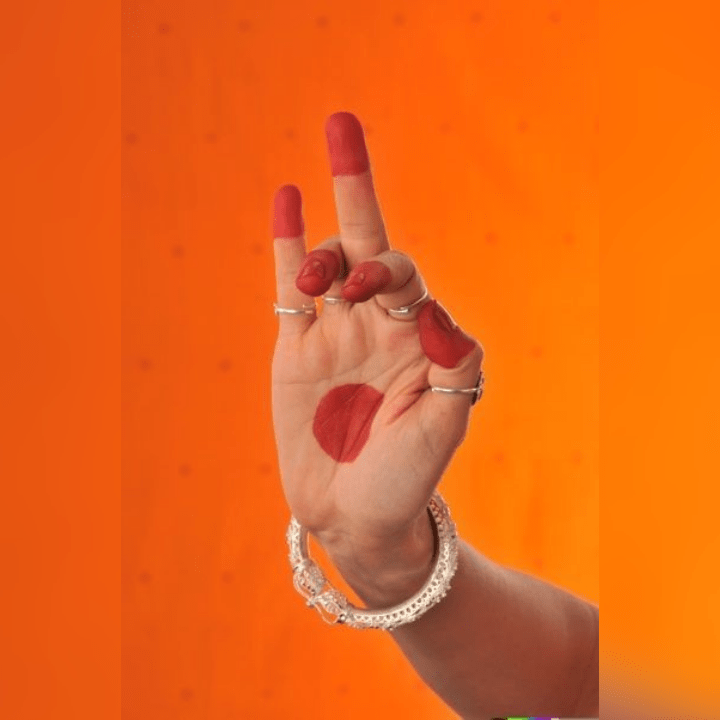
The alta decorations on the hands of an indian classical dancer as she does a hand mudra
Alta worn on the feet of an indian classical dancer

Alta (Also known as Mahawar or Red Bengal), is the vibrant red dye that is used to don women, mostly belonging to the Indian territories of Bengal, Bihar, Rajasthan and Orissa. Primarily worn on a bride’s hands and feet, Alta is even applied by Indian Classical Dancers, moreso to accentuate their dramatic hand and feet movements or mudras.
Made originally from Betel leaves ( commonly knows as the paan leaf), this red hue of the Alta, is significant of blood and hence stands for fertility and prosperity.
Of course, any Bangali reading this would know these details, but that’s exactly why I’m mentioning them. Not many would know that this custom of decorating the feet and hands with Alta (which is one of the ‘Solah Shringar’ mentioned in our Vedas), came before even the tradition of wearing Mehendi, in the history of Indian Bridal Adornments. ‘Henna’ or ‘Mehendi’ is a Muslim Influence brought about by the Mughals. There are even tales of Lord Krishna applying Alta on Radha’s feet which truly speak volumes of the Indianness of Alta much more than Mehendi.

Wikipedia.com ,amrapali.com,utsavfashion.com,sheroes.com ,pinterest

TANJORE PAINTINGS


As a child, I have often been fascinated by the glittering paintings that were hung along the hallway of my mama’s house. These resplendent masterpieces added a different aura to the whole place so much so that I still remember them, even after so many years of him having moved into his new house.
That very spirit of admiration for the same has seemed to reemerge as a consequence of my new found love for Indian culture.
My fascination knew no bounds when I delved deep into this age-old art form.
Dating back to the 16th century, the “Tanjore or Thanjavur” paintings can be known as the by-product of the Maratha invasion over South India; Tamil Nadu to be specific.
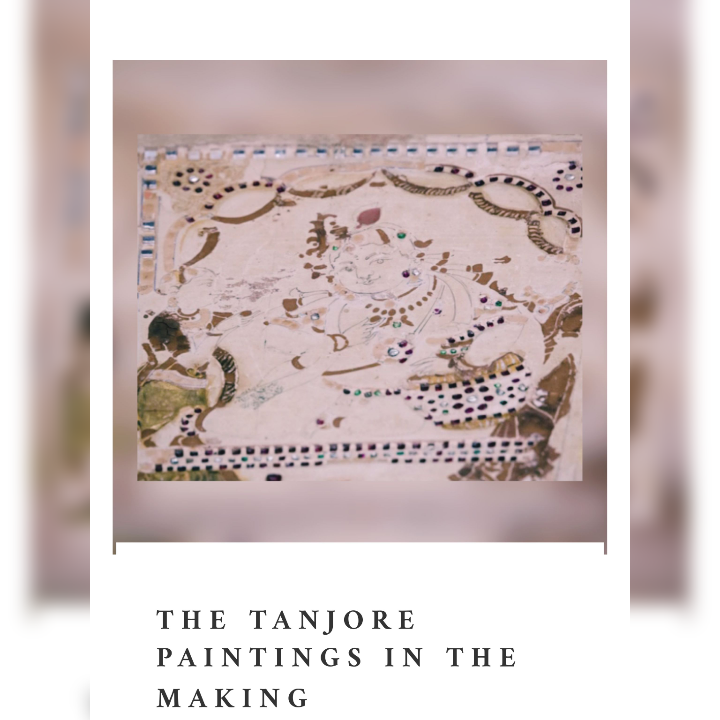
As an initial step, a canvas is made. A wooden board derived from the bark of a jackfruit tree was used as the base on top of which a cardboard sheet is pasted using indigenous gum, with a stretched piece of cloth over it. Then it is overcoated with a mixture of chalk and tamarind seed powder and finished up with an Emery paper to give it the required texture and form what is referred to as the ‘Palagai Padam’ by the locals of Tamil Nadu. (Palagai; wooden plank),Padam (painting).
The artists then sketch out sceneries from the Ramayana and the life of Krishna or even simple sketches of elephants, horses and cows in it with the help of templates. These pinpricked tracing sheets are placed on top of the cloth and dusted with charcoal dust. Originally relief areas were made over these sketches by using a mix of chalk powder, glue, gold paint and water which is now to be replaced by plaster of paris.22-carat gold foil is pasted on these embossed areas for the final touches and of course not to forget the colourful semi-precious stones used to accentuate the beauty of the effect.
With time the artisans shifted from natural dyes to synthetic colours. (dark colours for the border, Red, Blue and green for the background, Lord Vishnu in blue and Natraja in white).
Our Colonizers(the British)had created their version of the same beauty with lesser use of the gold foil but the traditional material and processes are undoubtedly very intriguing. Just like any other of our traditional art forms, even these fragments of our heritage need to be protected and popularized amongst the youth of today.

Picture and info credits:
http://www.dsource.in/resource/tanjore-paint-ing-tanjore-tamilnadu/contact-details
ing-tanjore-tamilnadu/contact-details
https://medium.com/@VinitaMathur/thanjavur-painting-a-traditional-form-of-art-d3fc7968fc07
http://www.varrmas.com/tanjorepaintings